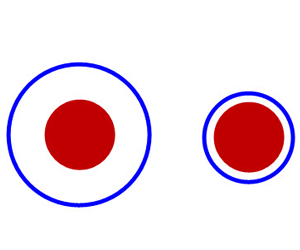
It’s possible that we are drilling larger cavities in our patients’ teeth than we need to.
A new study done in New Zealand and published in the journal PLOS One proposed that dentists may fall victim to a visual illusion that could affect treatment. The optical illusion, known as the Delboeuf Illusion, Professor Robert O'Shea, a psychology expert in visual perception from Southern Cross University, says all of the dentists drilled larger holes than necessary. He explained this due to an optical illusion which makes a small enclosed area (the decay) appear larger when surrounded by a larger area (the tooth).
In a test with 8 endodontists and 21 teeth, it was found that the clinicians increased average-sized holes by 0.59 mm, and larger-than-average holes by up to nearly 1.0 mm. Researchers say that although this specific test focused on dentistry exclusively, the principle of the Delboeuf Illusion could extend to other aspects of healthcare.
"We do not know if dentists are aware of this," Prof O'Shea said.
"The critical aspect for the illusion is the ratio between the size of the tooth and the size of the small area.
"We think that dentists think, either consciously or unconsciously, after they have made a hole of a particular size: 'That looks rather small - I need to make that hole bigger'."
Prof O'Shea says in light of the new research dentists should consider measuring the area that needs to be drilled, rather than relying on their eyes to determine how big the hole needs to be.