



Dental Nd:YAG lasers have a wavelength of 1064nm and they are free running pulsed lasers similar to Er:YAG in means of laser medium and laser production. This makes it work with very high peak powers per pulse although the clinical working average power is similar to diodes around 1 to 4W as its duty cycle is around %0.2.
Even thought it has very high peak powers in the range of kilowatts, the wavelength of 1064nm has absorption properties is similar to diodes rather than erbium; with the main absorption occurring in melanin and haemoglobin rather than water. This makes the indications of Nd:YAG laser parallel to the diodes’ with some improvements.
The main advantage of Nd:YAG laser over diodes is that they rarely need the carbonisation (initiation/activation) of the fibre thanks to its high peak power. This allows the laser to truly interact with the tissue and its components rather than creating a hot glass rod to unselectively vaporize tissue. This also enables the practitioner to use the same fibre or tip to disinfect or biomodulate the surgical site after incision or excision without cutting the tip of the fibre, provided that the tip has been kept clean during the intervention. It is also speculated that penetration for biomodulation is deeper with pulsed lasers, which helps more to gain deeper effects for healing, myorelaxation or analgesia.
The Nd:YAG laser has long been used for oral surgery as it was the first purpose built laser for dentistry. In addition to soft tissue interventions, it has even been tried on caries removal (Myers and McDaniel 1991) depending on the absorption of this wavelength in dark colour, however the absorption is not efficient enough like Er:YAG’s absorption in water. This leads to the need of using very high powers which caused thermal side effects and pulpal damage. After the trials on hard tissue, use of Nd:YAG for tissue removal was limited to soft tissues. (Fig 16)
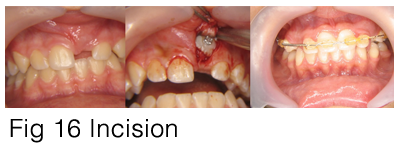
Any incision and excision on the soft tissue like gingivectomy, gingivoplasty, vestibular or lingual frenectomy, vestibuloplasty, granuloma or fibroma removal can be done with Nd:YAG (White 1998) with no bleeding. (Fig 17 and 18) It is always essential to be certain about the nature of the tissue that is being removed. The wound can be left for secondary healing without sutures or covering. Care should be taken with all soft tissue lasers to direct the laser parallel to the underlying bone or other anatomical structures like foremen or salivary glands. One example is the removal of ingrown tissue in the caries cavity. While removing such a tissue, the fibre should be directed oro-vestibularly rather than corona-apically to protect the bone supporting the papilla.

Nd:YAG has long been known for its bactericidal effect (Schultz et al. 1986, Rooney et al. 1994, Meral et al. 2003 and Harris et al. 2004) and has been used for periodontal treatment for this effect (Qadri et al. 2005, 20010 and 2011) and deepitelialization (Giannelli et al. 2012). The application of Nd:YAG in the pockets with water irrigation has given better and more consistent results. The disinfection can be carried out before scaling and root planing to decrease bacteraemia especially for immunosuppressed patients, making the operation area more visible and calculus easier to remove. The laser treatment can also be done after the initial phase of nonsurgical periodontal therapy with less thermal effect on the root surface, deep disinfection and deepitelialization. The short coming of soft tissue lasers are not being able to remove hard tissue or calculus, so combination of Nd:YAG with Er:YAG has been offered to combine the effects and advantages of two wavelengths; removal of the calculus and biofilm with Er:YAG and deepithelialization, disinfection, biostimulation and coagulating with the Nd:YAG.
Microorganisms were shown to reside in deep dentinal tubules up to 1100 µm; a depth classical irrigation with chemicals cannot reach. Nd:YAG is used in endodontics to have deeper disinfection in the dentinal walls and tubules, effective up to 1000µm (Klinke 1997, Bergmans et al. 2006). () Nd:YAG laser is also used to soften the gutta-percha (Vidučić et al. 2003) and to treat apical surface for apicoectomies (Pozza et al 2009)
Similar to diodes Nd:YAG is not absorbed well in hydroxi-apatite making a useful tool for cavity and post extraction socket disinfection in addition to root canal systems. It is known that microorganisms are left behind after extraction even if curettage of the site has been carried out. After caries removal microorganisms may also b left behind causing secondary caries or pulp irritation. Laser deep disinfection a useful additional step. Nd:YAG can also be used to coagulate the blood in the socket providing a stable clot, which is a prerequisite for a good bone fill.
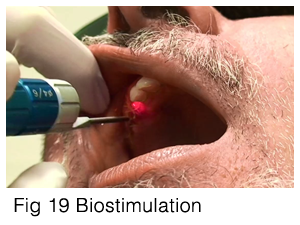
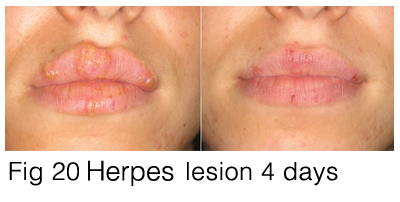
Nd:YAG is also know to exert biostimulatory effects when it penetrates the tissue (Chellini et al. 2010). (Fig 19) It was also shown to be as effective as splinting for TMJ problems (Demirkol 2014) and speed up mucositis healing (Usumez et al.2013). Herpes lesions are also treated to ease the uncomfortable feeling around the leasin and for a fast healing. (Fig. 20)
Nd:YAG lasers were stated to be efficacious for the treatment of dentin hypersensitivity (Sgolastra et al. 2013). The sensitivity can The superficial effect narrows down the dentinal tubule openings whereas the deeper effect acts as a long term analgesic on the pulp tissue affecting impulse delivery.
During prosthetic work, the Nd:YAG laser is very helpful for troughing before taking impressions or desensitizing prepared teeth if required.
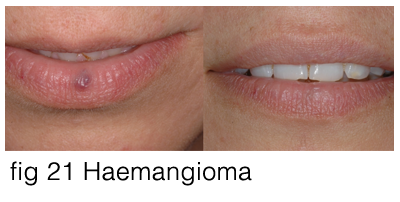
Non-invasive treatment of hemangioma may be needed for aesthetic reasons in the anterior area (Actis et al. 1993). (Fig 21)
Nd:YAG laser’s energy is strongly absorbed in haemoglobin, the lesion is coagulated, and it is either left to be removed by mast cells or ablated.
References
Actis A, Juri H, Gendelman H. Oral Hemangiomas Treated with Nd:YAG and CO2 Laser. Journal of Clinical Laser Medicine & Surgery Volume 11, Number 2, 1993.
Bergmans L, Moisiadis P, Teughels W, Van Meerbeek B, Quirynen M, Lambrechts P. Bactericidal effect of Nd:YAG laser irradiation on some endodontic pathogens ex vivo. Int Endod J. 2006 Jul;39(7):547-57.
Chellini F, Sassoli C, Nosi D, Deledda C, Tonelli P, Zecchi-Orlandini S, Formigli L, Giannelli M. Low pulse energy Nd:YAG laser irradiation exerts a biostimulative effect on different cells of the oral microenvironment: "an in vitro study". Lasers Surg Med. 2010 Aug;42(6):527-39.
Demirkol N, Sari F, Bulbul M, Demirkol M, Simsek I, Usumez A. ffectiveness of occlusal splints and low-level laser therapy on myofascial pain. Lasers Med Sci. 2014 Feb 7. [Epub ahead of print]
Giannelli M, Bani D, Viti C, Tani A, Lorenzini L, Zecchi-Orlandini S, Formigli L. Comparative evaluation of the effects of different photoablative laser irradiation protocols on the gingiva of periodontopathic patients. Photomed Laser Surg. 2012 Apr;30(4):222-30.
Harris DM, Yessik M (2004) Therapeutic ratio quantifies laser antisepsis: ablation of Porphyromonas gingivalis with dental lasers. Lasers in Surgery and Medicine 35(3):206-13.
Klinke T, Klimm W, Gutknecht N. Antibacterial effects of Nd:YAG laser irradiation within root canal dentin. J Clin Laser Med Surg. 1997 Feb;15(1):29-31.
Meral G, Tasar F, Kocagöz S, Sener C (2003) Factors affecting the antibacterial effects of Nd:YAG laser in vivo. Lasers in Surgery and Medicine 32(3):197-202.
Myers TD, McDaniel JD. The pulsed Nd:YAG dental laser: review of clinical applications. J Calif Dent Assoc. 1991 Nov;19(11):25-30.
Pozza DH, Fregapani PW, Xavier CB, Weber JB, Oliveira MG. CO(2), Er: YAG and Nd:YAG lasers in endodontic surgery. J Appl Oral Sci. 2009 Nov-Dec;17(6):596-9.
Qadri T, Javed F, Poddani P, Tunér J, Gustafsson A. Long-term effects of a single application of a water-cooled pulsed Nd:YAG laser in supplement to scaling and root planing in patients with periodontal inflammation.Lasers Med Sci. 2011 Nov;26(6):763-6
Qadri T, Poddani P, Javed F, Tunér J, Gustafsson A. A short-term evaluation of Nd:YAG laser as an adjunct to scaling and root planing in the treatment of periodontal inflammation. J Periodontol. 2010 Aug;81(8):1161-6.
Qadri T, Miranda L, Tunér J, Gustafsson A. The short-term effects of low-level lasers as adjunct therapy in the treatment of periodontal inflammation. J Clin Periodontol. 2005 Jul;32(7):714-9.
Rooney J, Midda M, Leeming J (1994) A laboratory investigation of the bactericidal effect of a Nd:YAG laser. British Dental Journal 176(2):61-4.
Schultz RJ, Harvey GP, Fernandez-Beros ME, Krishnamurthy S, Rodriguez JE, Cabello F (1986) Bactericidal effects of the Neodymium:YAG laser: in vitro study. Lasers in Surgery and Medicine 6(5):445-8.
Sgolastra F, Petrucci A, Severino M, Gatto R, Monaco A. Lasers for the treatment of dentin hypersensitivity J Dent Res. 2013 Jun;92(6):492-9.
Usumez A, Cengiz B, Oztuzcu S, Demir T, Aras MH, Gutknecht N. Effects of laser irradiation at different wavelengths (660, 810, 980, and 1,064 nm) on mucositis in an animal model of wound healing. Lasers Med Sci. 2013 May 1. [Epub ahead of print]
White JM, Chaudhry SI, Kudler JJ, Sekandari N, Schoelch ML, Silverman S Jr.Nd:YAG and CO2 laser therapy of oral mucosal lesions. J Clin Laser Med Surg. 1998 Dec;16(6):299-304.
Schultz et al. 1986, Rooney et al. 1994, Meral et al. 2003, Harris et al. 2004
Vidučić D, Jukić S, Karlović Z, Božić Z, Miletić I, Anić I. Removal of gutta-percha from root canals using an Nd:YAG laser International Endodontic Journal Volume 36, Issue 10, pages 670–673, October 2003

Dental Business Management Tips
Read our exclusive dental tips for Dental Business Management
learn how to manage and communicate with your patient from our expert

Dr. Anna Yiannikos
DDS, MSc, LSO, MBA
Course Leader/Director of DBA

Webinar

Asnsnportal.com Webinars deliver a unique web educational experience through both its live interactiove seminars and recorded seminars...