


Cross-discipline education and constant perusal of the scientific literature is a must for the contemporary practitioner : Thus, a periodontologist must have a basic understanding of advanced immunology, the immunologist must understand some advanced biochemistry, and the biochemist needs to remain updated in advanced physics and mathematics, In addition, all can benefit from a good dose of philosophy, which is indispensable for gaining a perspective on matters and for the conceptualization of complex theories,
The concept of "gaining a perspective on matters" begs the question, "Are we seeing a new "renaissance" taking revenge on the ultra-specialists from the seventies?" ls this generation, who were sadly lacking in even the most rudimentary skills required for good communication and understanding, isolated in their "ivory towers" and simply "too intelligent" to impart the essence of their arcane knowledge beginning to wane? ls a new generation, a "missing link" between the intellectually gifted and the "generic" practitioner beginning to emerge? lf that be true, it would indeed be a boon to all mankind. One can only hope for the best and for the proliferation of this rare "new breed".
Going back to the interactions between an implant and its surrounding tissues, the works of Professor Per Ingvar Branemark had the merit to clearly establish the basics of osseointegration and show that bone heals uneventfully when properly placed in close contact with Titanium. But that was only a beginning. Too many questions were left with no good answer; why do we witness implant failures, usually at early stage of bone repair? Do all the implant designs trigger the same response from the bone? is bone healing always the same, regardless of thread design, surface characteristics, load or no-load, degree of approximation, etc.?
For example consider the multitude of screw designs on the market, with so many surface finishes, but no real study to validate the merits of said refinements, Instead, we are bombarded by advertising claims, numerous anecdotal and clinical case reports, a modicum of literature dispensed from Universities (on behalf of those interests providing multi-million dollar grants) but recently we have witnessed some comprehensive research-driven designs.
An example of the latter can be seen in the work of Berglundh et al. This report demonstrated that changing thread design and drilling sequence could significantly alter the kinetics of bone healing, Coelho et al2 also provided evidenced that a thread design change, combined with a change in drilling sequence would speed up bone formation by a factor as great as ten times. The data are impressive, and even more impressive when you consider the fact that these experiments were still looking at a macro scale; where we can see changes that were made to the implant and could be discerned by the naked eye.
The history of surface modifications has also undergone its share of trial and error; going from machines surfaces to TPS and plasma spray Hydroxyapatite. A consensus has emerged from the scientific community with respect to this characteristic, and the verdict has been established: micro-rough surfaces are the pick of the litter. Despite the fact that the technologies employed to generate these surfaces may vary from one manufacture to another; the same profile and the same surface chemistry will provide the same biological response. An important difference to note in this advance is that whereas the changes in thread design and drilling sequences are discernible by the human eye, the perception of significant surface changes can only be determined via microscopic examination. Kikuchi et al3 have shown that the sur{ace characteristics that exist at this level are essential for platelet activation. They have concluded that surface profilometry at the microscale level is more important than surface chemistry At this level of technology, the changes are on the micro scale,
Nowadays, most of the implant manufactures have remained at this level even if many use the "buzz-word"of nanotechnology. Nanotechnology is a relatively new science (under 30 years old) and its development increased exponentially in the nineties with the introduction of the Scanning Tunneling Microscope and Atomic Force. The discipline encompasses various areas: nanomaterials and molecular nanotechnology. It is fascinating to discover that a well known periodic element as stable and chemically inert as Gold (Au), functions as a potent catalyst when used at a nanoscale. Molecular nanotechnology consists of building complex structures, using the atoms as elemental bricks.
Nanoprofilometry is often confused and taken for nanotechnology, but they are not synonymous. They are as different as "looking" versus "doing".
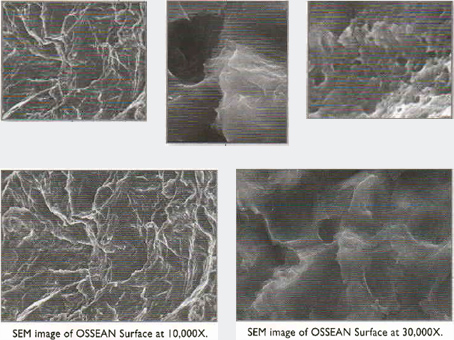
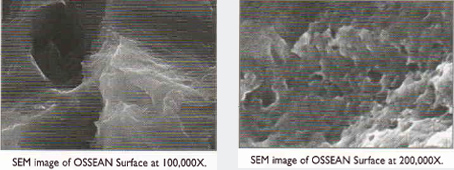
Vetrone et al recently showed in 2008 that nanostructured surfaces influence the behavior of various cell types and even alter the potential for the differentiation of stem cells. The Ossean@ project was initiated under my responsibility 2005, and the surface was launched in2007.lt is characterized by a fractal structure with the same pattern repeating itself from the macroscale to the microscale, then to the nanoscale and beyond. There is no addition of any particle of any kind on the surface but rather an elemental modification of the surface chemistry within the Titanium Oxide layer via the incorporation of Calcium Phosphate. High resolution SEM shows at 200,000X magnification,the nanotexture of the surface. Pristine.Devoid of any particle or contaminant.Calcium Phosphate is evidenced under XPS-ESCA or Auger Spectroscopy. The clinical ramifications are impressive:Marin and Als showed values of torque removal at two weeks post-implantation to be double on Ossean@ surface implants when compared to a standard Blasted/Acid etched implant. Another paper from Coelho and Al6 (to be published),shows a comparative study between Ossean@ lntra-Lock implants, and two other leading brand implants, (same size, same shape, same thread pitch.) The first part of the study consists in measuring the torque removal at one week and three weeks after implant placement. The results show a 500% increase of torque value at one week for the Intra-Lock Ossean@ surface implant oven the other two implants.Those results are mind-boggling when we put in perspective the fact that it was a given that osseointegration has to go through a catabolic phase prior entering the anabolic phase. It is postulated that the Ossean@ surface changes the genetic "fate" or the coding of the surrounding cells.
Similar conclusions can be drawn from another study to be published by Piatelli et al7. ln this human study,Ossean@ surface implants have been compared to the same implant shape with a conventional Blasted/Acid Etched surface. An osteocyte count has been performed adjacent to the implant surface and at distance. The results show a 50% increase of those precious cells compared to the control.
These studies and other data conflrm the fact that we are not only working at the nanoscale, but also within the true realm ofnanotechnology, at the molecular level.
These recent findings are changing 'the paradigm of tissue healing around implants, and will enable us to define the process of osseointegration with greater precision and depth of understanding
REFERENCES
- Berglundh T. Abrahamsson l, Lang NP, Lindhe J, De novo alveolar bone formation adjacent to endosseous implants A model study in the dog Clin Oral lmpl Res, 14,2003,251-262.
- Coelho & Al Early Bone Healing Around Different implant Bulk Designs and Surgical Techniques, A Study in Dogs, Clinical implant Dentistry and Related Research, In Press.
- Lena Kikuchi & Al. Platelet interactions with calcium-phosphate-coated surfaces. Biomaterials, Volume 25, lssue 25, Pages 5267 -5426 (September 2005).
- Vetrone F, & Al, Nanoscale Oxidative Patterning of Metallic Surfaces to Modulate Cell Activity and Fate. NANOLETTERS, VoI. xx, No, x, 2008
- Marin C. & AI Removal Torque and Histomorphometric Evaluation of Bioceramic Grit-Blasted/Acid-Etched and Dual Acid-Etched implant Surfaces: An Experimental Study in Dogs, J of Perio, Volume 79 . Number 10, Oct 2008, (1942-1949). Doi | 0 I 902/jop,2008,080 | 06,
- Coelho PG. Personal communication, Manuscript in preparation, 2008,
- Piattelli & Al, Histomorphometric Evaluation of Bioceramic Molecular impregnated and Dual Acid Etched implant Surfaces in the Human Posterior Maxilla. Clinical implant Dentistry and Related Research. In Press