

A Harvard-led team is the first to demonstrate the ability to use low-power light to trigger stem cells inside the body to regenerate tissue, an advance they reported in Science Translational Medicine. The research, led by Wyss Institute Core Faculty member David Mooney, Ph.D., lays the foundation for a host of clinical applications in restorative dentistry and regenerative medicine more broadly, such as wound healing, bone regeneration, and more.
Senior author David J. Mooney, who is Robert P. Pinkas Family Professor of Bioengineering at the Harvard School of Engineering and Applied Sciences, and colleagues report their study in the journal Science Translational Medicine.
The team used a low-power laser to trigger human dentalstem cells to form dentin, the hard tissue that is similar to bone and makes up the bulk of teeth. What's more, they outlined the precise molecular mechanism involved, and demonstrated its prowess using multiple laboratory and animal models.
Currently, when using stem cells, scientists have to remove them from the body, work with them in the lab, and then put them back in the body. Translating the results of research using this approach to the clinic involves numerous hurdles - both regulatory and practical.
But the laser-based method the Harvard-led team is working on should be much easier to translate to the clinic, as Prof. Mooney explains:
"Our treatment modality does not introduce anything new to the body, and lasers are routinely used in medicine and dentistry, so the barriers to clinical translation are low. It would be a substantial advance in the field if we can regenerate teeth rather than replace them."
The experiment
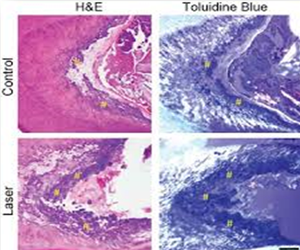
Arany “ the lead auther and dentist” took rodents to the laboratory version of a dentist's office to drill holes in their molars, treat the tooth pulp that contains adult dental stem cells with low-dose laser treatments, applied temporary caps, and kept the animals comfortable and healthy. After about 12 weeks, high-resolution x-ray imaging and microscopy confirmed that the laser treatments triggered the enhanced dentin formation.
"It was definitely my first time doing rodent dentistry," said Arany, who faced several technical challenges in performing oral surgery on such a small scale. The dentin was strikingly similar in composition to normal dentin, but did have slightly different morphological organization. Moreover, the typical reparative dentin bridge seen in human teeth was not as readily apparent in the minute rodent teeth, owing to the technical challenges with the procedure.
Underlying molecular mechanism
Following this early success, the team took it to the next stage by performing a series of experiments, using cultured tissue, to find out what happens at the molecular level when laser light triggers new tissue formation
They discovered that a common regulatory cell protein called transforming growth factor beta-1 (TGF-β1) plays a key role in triggering dental stem cells to grow into dentin.
Until a molecule comes along and activates it, TGF-β1 exists in a standby mode. What the team discovered is a domino effect that begins when the laser light induces reactive oxygen species (ROS), and these in turn activate the TGF-β1 complex, which then triggers the stem cells to differentiate into dentin. ROS are chemically active oxygen-containing molecules that play a key role in many cell functions.
The discovery is significant because it confirms scientifically what has always been believed from reported anecdotes about low-level light therapy, also known as photobiomodulation. Since the 1960s, there have been anecdotal reports of doctors achieving remarkable results with laser light such as rejuvenating skin, stimulating hair growth, and other wonders.
It is also interesting that the same type of laser therapy can be used to remove unwanted skin material and hair - it all depends on how you use the laser.
The study helps to clarify some of the inconsistent evidence about the clinical effects of low-power lasers on tissue, and marks the first time that scientists have come to grips with the underlying molecular mechanisms involved.
"The scientific community is actively exploring a host of approaches to using stem cells for tissue regeneration efforts," said Wyss Institute Founding Director Don Ingber, M.D., Ph.D., "and Dave and his team have added an innovative, noninvasive and remarkably simple but powerful tool to the toolbox."
Next Arany aims to take this work to human clinical trials. He is currently working with his colleagues at the National Institute of Dental and Craniofacial Research (NIDCR), which is one of the National Institutes of Health (NIH), to outline the requisite safety and efficacy parameters. "We are also excited about expanding these observations to other regenerative applications with other types of stem cells," he said.

Dental Business Management Tips
Read our exclusive dental tips for Dental Business Management
learn how to manage and communicate with your patient from our expert

Dr. Anna Yiannikos
DDS, MSc, LSO, MBA
Course Leader/Director of DBA

Webinar

Asnsnportal.com Webinars deliver a unique web educational experience through both its live interactiove seminars and recorded seminars...